



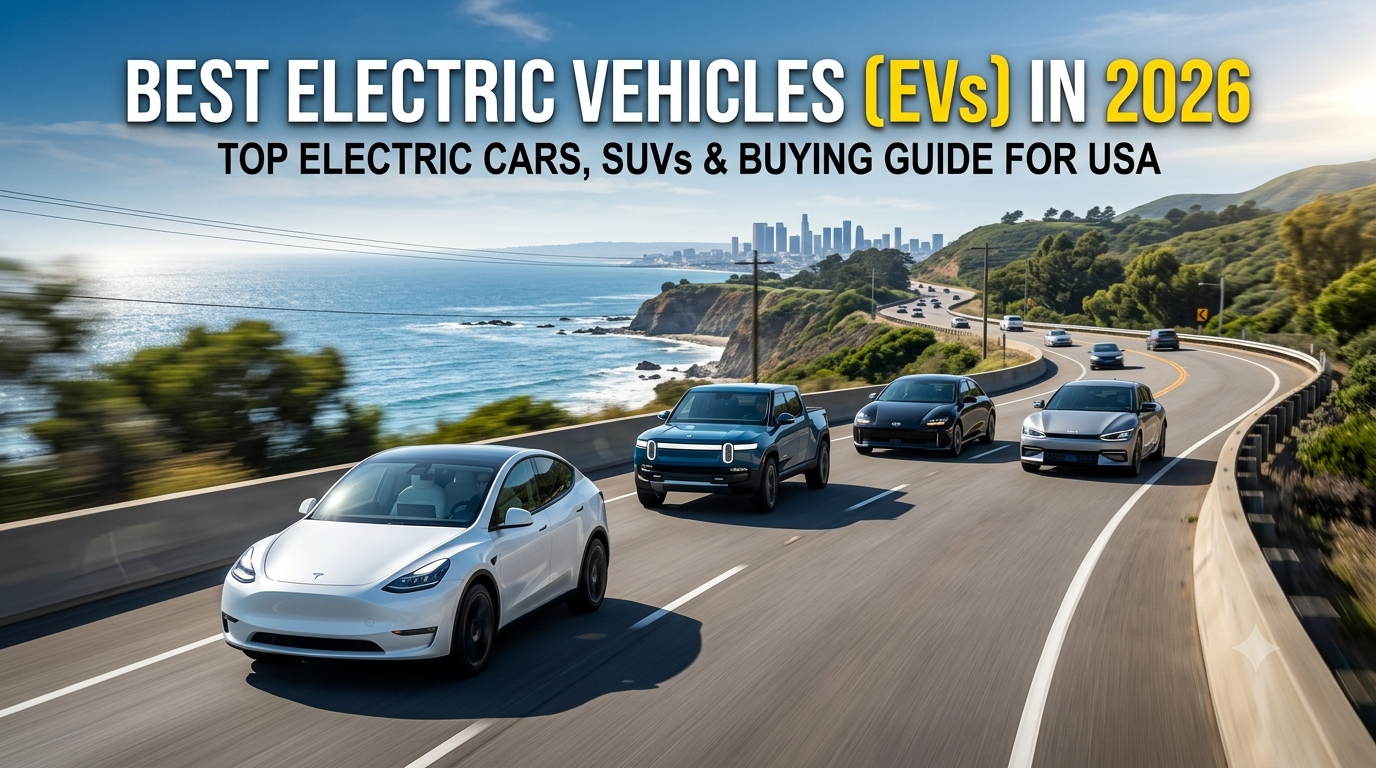
Best Electric Vehicles (EVs) in 2026: The Complete USA Buyer’s Guide
Electric Vehicles (EVs) are no longer the future—they’re the present. Across the United States, more drivers are switching from gasoline-powered vehicles to electric cars because of lower operating costs, better performance, government incentives, and rapidly expanding charging infrastructure.
Whether you’re looking for an affordable commuter car, a luxury electric SUV, or a powerful electric pickup truck, today’s EV market offers more choices than ever before.
In this comprehensive guide, you’ll learn everything you need to know before buying an electric vehicle in 2026, including the best EV models, charging options, battery range, ownership costs, tax credits, and the latest trends shaping America’s electric future.
Why Electric Vehicles Are Becoming So Popular in the USA
Over the past five years, EV adoption has accelerated dramatically. Several factors are driving this growth:
- Rising fuel prices
- Federal and state tax incentives
- Lower maintenance costs
- Better battery technology
- Increased driving range
- More public charging stations
- Growing environmental awareness
Modern EVs are no longer limited to short city commutes. Many now offer over 350 miles of range, making them practical for road trips across the United States.
What Is an Electric Vehicle (EV)?
An Electric Vehicle is a car powered entirely by electricity instead of gasoline or diesel.
Instead of an internal combustion engine, EVs use:
- Electric motor
- Rechargeable lithium-ion battery
- Battery management system
- Regenerative braking technology
Drivers recharge the battery using:
- Home chargers
- Workplace charging stations
- Public charging networks
- Fast DC charging stations
How Electric Vehicles Work
Unlike traditional vehicles, EVs have far fewer moving parts.
The basic process works like this:
- Electricity is stored inside the battery pack.
- The battery sends power to an electric motor.
- The electric motor turns the wheels.
- During braking, regenerative braking converts kinetic energy back into electricity.
This process is significantly more efficient than gasoline engines.
Benefits of Buying an Electric Vehicle
1. Lower Fuel Costs
Electricity is considerably cheaper than gasoline in most U.S. states.
Instead of paying:
- $60–90 per gas tank
Many EV owners spend:
- $10–20 for a full charge at home
Over several years, the savings become substantial.
2. Reduced Maintenance
EVs eliminate many expensive maintenance items:
- No oil changes
- No spark plugs
- No transmission fluid
- No exhaust system
- No timing belts
The result is fewer repair bills over the life of the vehicle.
3. Instant Acceleration
Electric motors deliver maximum torque immediately.
Even affordable EVs accelerate faster than many gasoline sports cars.
Benefits include:
- Faster merging
- Quicker passing
- Smooth acceleration
- Better driving experience
4. Quiet Driving
Because there’s no combustion engine:
- Less vibration
- Less cabin noise
- More comfortable commuting
- Better highway driving
Luxury automakers especially emphasize cabin silence in their electric vehicles.
5. Environmentally Friendly
EVs produce:
- Zero tailpipe emissions
- Less air pollution
- Reduced greenhouse gases
When charged using renewable energy, their environmental impact becomes even smaller.
Types of Electric Vehicles
Not every electric vehicle works the same way.
Battery Electric Vehicle (BEV)
These run entirely on electricity.
Examples include:
- Tesla Model 3
- Hyundai Ioniq 5
- Rivian R1T
Pros:
- Zero emissions
- Lowest operating cost
- No gasoline required
Plug-in Hybrid Electric Vehicle (PHEV)
These combine:
- Gasoline engine
- Electric motor
Drivers can use electricity for short trips and gasoline for longer drives.
Ideal for buyers not ready to switch completely to electric.
Hybrid Electric Vehicle (HEV)
Traditional hybrids cannot be plugged in.
Examples include:
- Toyota Prius
- Honda Accord Hybrid
These use regenerative braking to recharge the battery automatically.
Best Electric Vehicles to Buy in 2026
1. Tesla Model 3
Still one of America’s most popular EVs.
Highlights
- Excellent range
- Fast charging
- Advanced Autopilot
- Minimalist interior
- Strong resale value
Perfect for:
- Daily commuting
- Families
- First-time EV buyers
2. Tesla Model Y
The best-selling electric SUV continues dominating the U.S. market.
Pros:
- Spacious cargo area
- Long driving range
- AWD availability
- Strong Supercharger access
Ideal for families needing additional space.
3. Hyundai Ioniq 5
One of the highest-rated EVs available today.
Features include:
- Ultra-fast charging
- Futuristic design
- Comfortable cabin
- Advanced safety technology
Many reviewers consider it one of the best all-around EVs available.
4. Kia EV9
For buyers wanting a three-row electric SUV, the Kia EV9 has become a standout choice.
Key advantages:
- Family-friendly seating
- Large cargo capacity
- Premium interior
- Excellent safety ratings
Perfect for larger households.
5. Ford Mustang Mach-E
Ford successfully blended performance with practicality.
Why buyers love it:
- Strong acceleration
- Modern technology
- Comfortable ride
- Competitive pricing
Available in multiple trims for different budgets.
6. Chevrolet Equinox EV
One of the most affordable electric SUVs in America.
Highlights:
- Budget-friendly pricing
- Excellent driving range
- Modern infotainment
- Good value for money
Ideal for first-time EV owners.
Best Luxury Electric Vehicles
Luxury EV competition has become intense.
Popular options include:
Lucid Air
Known for:
- Incredible driving range
- Premium interior
- High performance
- Advanced technology
Mercedes-Benz EQS
Offers:
- Executive-level comfort
- Massive digital dashboard
- Smooth ride quality
- Premium craftsmanship
BMW i5
Combines:
- Luxury
- Sporty handling
- Excellent cabin quality
- Advanced driver assistance
Best Electric Pickup Trucks
Pickup trucks remain America’s favorite vehicle category.
Electric options now compete directly with gasoline trucks.
Ford F-150 Lightning
Excellent for:
- Contractors
- Families
- Daily driving
- Towing
Rivian R1T
One of the most capable adventure trucks.
Features include:
- Off-road capability
- Luxury interior
- Long range
- Innovative storage solutions
Chevrolet Silverado EV
Offers:
- Long driving range
- Large towing capacity
- Modern technology
- Spacious interior
EV Charging Explained
Understanding charging is essential before buying an electric vehicle.
Level 1 Charging
Uses a regular household outlet.
Charging speed:
Approximately 3–5 miles of range per hour.
Best for:
- Overnight charging
- Low-mileage drivers
Level 2 Charging
Most homeowners install Level 2 chargers.
Charging speed:
20–40 miles of range per hour.
Most EV owners rely on this option daily.
DC Fast Charging
The fastest available charging method.
Many modern EVs recharge from:
10% to 80%
in approximately:
20–35 minutes.
Perfect for:
- Road trips
- Highway travel
- Long-distance driving
How Much Driving Range Do You Really Need?
Many shoppers worry about range anxiety.
Here’s a simple guideline:
| Driver Type | Recommended Range |
|---|---|
| City driving | 220+ miles |
| Daily commuting | 250–300 miles |
| Frequent highway travel | 320+ miles |
| Road trip enthusiasts | 350–450 miles |
Today’s EVs easily meet the needs of most American drivers.
Battery Life and Warranty
Modern EV batteries are built to last.
Most manufacturers provide:
- 8-year warranty
- 100,000-mile battery coverage
- Some extend even further
Battery degradation is also much slower than many buyers initially feared.
EV Ownership Costs vs. Gasoline Cars
One of the biggest reasons Americans are switching to electric vehicles is the lower total cost of ownership. While many EVs have a higher purchase price, the long-term savings often make up for the initial investment.
Cost Comparison
| Expense | Electric Vehicle | Gasoline Vehicle |
|---|---|---|
| Fuel/Energy | Low | High |
| Oil Changes | None | Required |
| Engine Maintenance | Minimal | Frequent |
| Transmission Repairs | Rare | Possible |
| Brake Wear | Lower (Regenerative Braking) | Higher |
| Annual Maintenance | Lower | Higher |
An average U.S. driver can save thousands of dollars over five to ten years by driving an EV, especially if they charge at home during off-peak electricity hours.
Federal EV Tax Credits in the USA
The U.S. government continues to encourage EV adoption through federal incentives. Depending on the vehicle, battery sourcing, and buyer eligibility, some new electric vehicles may qualify for tax credits.
Potential benefits include:
- Up to $7,500 for qualifying new EVs
- Incentives for eligible used EVs
- State-level rebates in certain states
- Utility company discounts for installing home chargers
Before purchasing, always verify the latest federal and state incentive programs, as eligibility requirements can change.
Best Affordable Electric Vehicles in 2026
Buying an EV doesn’t have to break the bank. Several manufacturers now offer budget-friendly options with excellent range and modern technology.
1. Chevrolet Equinox EV
Why it’s a great value:
- Affordable pricing
- Spacious SUV design
- Competitive driving range
- Modern safety features
2. Hyundai Kona Electric
Perfect for:
- City commuters
- Small families
- First-time EV buyers
Highlights:
- Compact size
- Efficient battery
- Comfortable interior
- Good reliability
3. Nissan Leaf
Although one of the oldest EV models, it remains popular due to:
- Affordable pricing
- Proven reliability
- Easy maintenance
- Simple charging experience
4. Kia Niro EV
Offers an excellent balance between price and practicality.
Benefits include:
- Comfortable cabin
- Smooth ride
- Good cargo space
- Long warranty coverage
Electric SUVs vs. Electric Sedans
Choosing between an electric SUV and an electric sedan depends on your lifestyle.
| Feature | Electric SUV | Electric Sedan |
|---|---|---|
| Cargo Space | Excellent | Moderate |
| Passenger Room | Larger | Comfortable |
| Efficiency | Slightly Lower | Higher |
| Driving Position | Higher | Lower |
| Family-Friendly | Excellent | Good |
| Road Trips | Excellent | Excellent |
| City Driving | Good | Excellent |
Choose an Electric SUV If You:
- Have a growing family
- Need extra cargo space
- Travel frequently
- Enjoy a higher seating position
Choose an Electric Sedan If You:
- Commute daily
- Want maximum efficiency
- Prefer sporty handling
- Drive mainly in urban areas
Home Charging vs. Public Charging
Home Charging
Most EV owners charge at home overnight.
Advantages include:
- Lower electricity rates
- Convenience
- Fully charged every morning
- Reduced reliance on public chargers
A Level 2 home charger is recommended for most households.
Public Charging
Public charging stations are becoming increasingly common across the United States.
You’ll find chargers at:
- Shopping centers
- Grocery stores
- Hotels
- Office buildings
- Rest stops
- Highway service plazas
Fast charging networks make long-distance travel much easier than it was just a few years ago.
EV Maintenance Guide
Electric vehicles require significantly less maintenance than traditional gasoline cars.
Regular Maintenance Includes:
- Tire rotations
- Tire pressure checks
- Cabin air filter replacement
- Brake fluid inspection
- Windshield washer fluid refill
- Software updates
- Battery health inspections
Because EVs have fewer moving mechanical parts, maintenance visits are generally less frequent and less expensive.
How Long Do EV Batteries Last?
Battery technology has improved dramatically.
Typical battery lifespan:
- 10–20 years
- 150,000–300,000+ miles
Most manufacturers back their batteries with warranties of at least 8 years or 100,000 miles, giving buyers added confidence.
Many EV batteries retain a high percentage of their original capacity even after years of daily use.
Common EV Myths Debunked
Myth 1: EVs Don’t Have Enough Range
Reality: Many modern EVs now offer 300–400+ miles of driving range on a single charge, making them suitable for most drivers.
Myth 2: Charging Takes Too Long
Reality: While home charging happens overnight, DC fast chargers can recharge many EVs from 10% to 80% in about 20–35 minutes.
Myth 3: EV Batteries Wear Out Quickly
Reality: Today’s lithium-ion batteries are engineered for long-term durability, with slow degradation under normal driving conditions.
Myth 4: EVs Can’t Handle Cold Weather
Reality: Cold temperatures can reduce range temporarily, but modern battery management systems and heat pumps help maintain performance in winter climates.
Myth 5: Electric Cars Aren’t Powerful
Reality: Electric motors deliver instant torque, allowing many EVs to accelerate faster than comparable gasoline-powered vehicles.
Are Electric Vehicles Good for Road Trips?
Absolutely. Road-tripping in an EV is becoming easier every year thanks to:
- Expanded fast-charging networks
- Longer battery ranges
- Improved route-planning software
- Better charger availability along major highways
Before a long journey:
- Plan charging stops in advance.
- Check charger availability using your vehicle’s navigation or charging apps.
- Charge to the recommended level before departure.
Tips for First-Time EV Buyers
If you’re purchasing your first electric vehicle, keep these tips in mind:
- Determine your daily driving distance.
- Compare battery range across models.
- Install a Level 2 home charger if possible.
- Research federal and state incentives.
- Consider insurance costs.
- Test-drive multiple EVs before deciding.
- Review charging network compatibility.
- Think about future resale value.
Frequently Asked Questions (FAQs)
Are electric vehicles cheaper to maintain?
Yes. EVs typically require less maintenance because they have fewer moving parts and do not need oil changes or many engine-related services.
How much does it cost to charge an EV?
The cost depends on local electricity rates and battery size, but charging at home is generally much less expensive than filling a gasoline tank.
Can I charge an EV at home?
Yes. Every EV can be charged at home using either a standard outlet or a faster Level 2 charger.
How often do EV batteries need replacement?
Most EV batteries are designed to last well beyond 150,000 miles, and many owners never need a replacement during the vehicle’s lifespan.
Are electric vehicles safe?
Yes. Modern EVs undergo rigorous crash testing and often include advanced safety technologies such as automatic emergency braking, lane-keeping assistance, adaptive cruise control, and collision avoidance systems.
The Future of Electric Vehicles in America
The U.S. EV market is expected to continue growing as manufacturers invest heavily in:
- Longer-range batteries
- Faster charging technology
- More affordable EV models
- Improved battery recycling
- Enhanced autonomous driving features
- Expanded public charging infrastructure
Consumers can also expect a wider variety of electric sedans, SUVs, pickup trucks, and luxury models in the coming years.
Final Verdict
Electric vehicles have evolved from niche products into practical, reliable, and cost-effective transportation for millions of Americans. With lower operating costs, impressive performance, advanced technology, and an ever-growing charging network, there has never been a better time to consider making the switch.
Whether you’re searching for an affordable commuter car, a family-friendly SUV, or a high-performance electric truck, the 2026 EV market offers a model to fit nearly every lifestyle and budget.
By evaluating your driving habits, charging options, and available incentives, you can choose an electric vehicle that delivers long-term value while helping reduce your environmental impact.
