



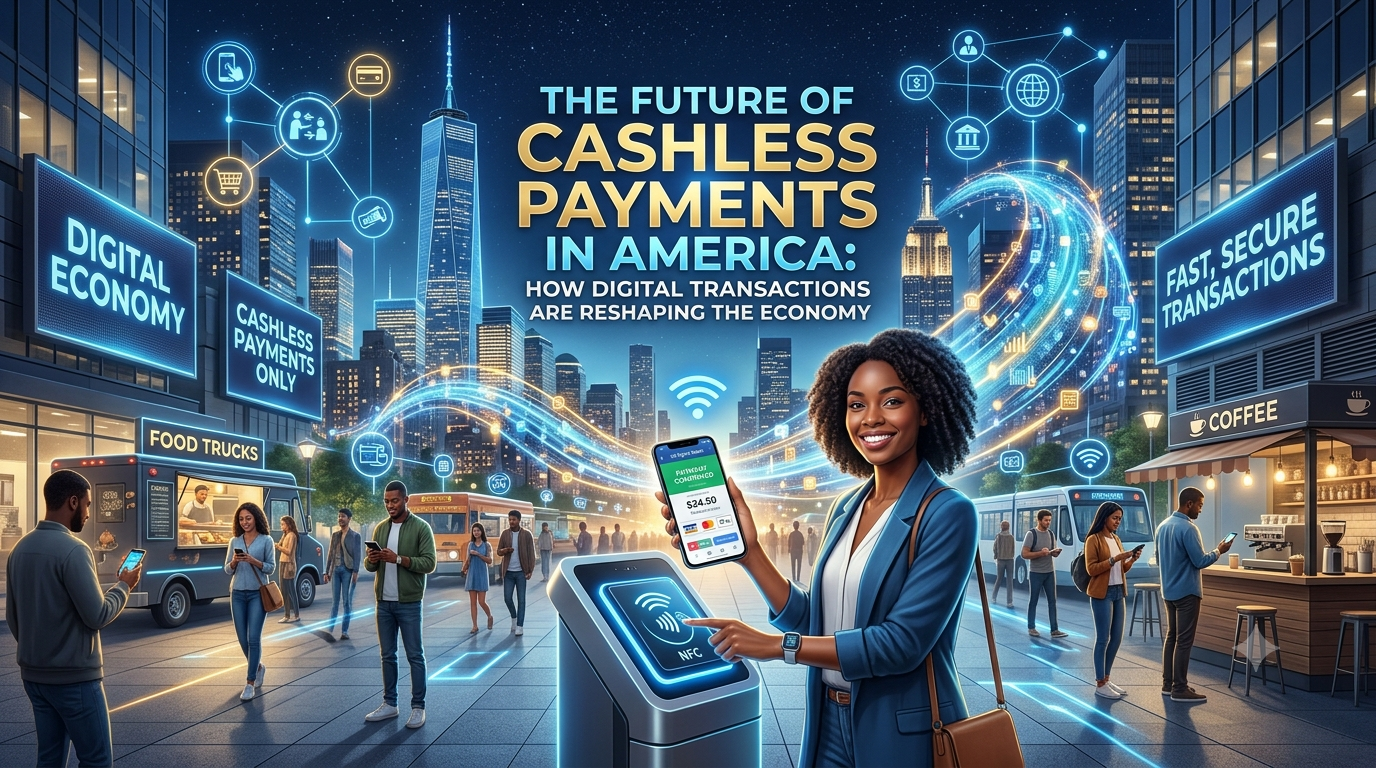
The Future of Cashless Payments in America
The way Americans pay for goods and services has changed dramatically over the past decade. Cash was once king, but today, digital payment methods have become the preferred choice for millions of consumers across the United States. Whether purchasing groceries, ordering food online, paying utility bills, or sending money to friends, Americans increasingly rely on smartphones, credit cards, debit cards, and digital wallets instead of physical cash.
The future of cashless payments in America looks even more promising. Advancements in financial technology (FinTech), artificial intelligence, blockchain, biometric authentication, and real-time payment systems are creating a faster, safer, and more convenient payment ecosystem.
Businesses are also embracing digital transformation because cashless transactions reduce operational costs, improve customer experience, and increase efficiency. At the same time, consumers enjoy greater convenience, enhanced security, and seamless shopping experiences both online and offline.
In this comprehensive guide, we’ll explore how America is moving toward a cashless economy, the technologies driving this transition, the benefits and challenges involved, and what consumers and businesses can expect in the coming years.
What Are Cashless Payments?
Cashless payments refer to financial transactions completed without using physical currency such as dollar bills or coins. Instead, money is transferred electronically between banks, payment providers, or financial institutions.
Common cashless payment methods include:
- Credit cards
- Debit cards
- Digital wallets
- Mobile payment apps
- Contactless tap-to-pay cards
- Online bank transfers
- QR code payments
- Peer-to-peer payment apps
- Buy Now, Pay Later (BNPL) services
Today, almost every major retailer in America accepts multiple forms of digital payment, making cash increasingly optional rather than necessary.
Why America Is Moving Toward a Cashless Society
Several factors are accelerating the transition toward digital payments across the United States.
1. Consumer Convenience
Modern consumers value speed and simplicity. Instead of carrying cash or waiting for change, shoppers can simply tap their phone or card to complete purchases in seconds.
Digital payments eliminate many everyday inconveniences associated with cash, including:
- Counting bills
- Carrying coins
- Visiting ATMs
- Handling exact change
This convenience has become one of the biggest reasons Americans increasingly prefer electronic payments.
2. Growth of E-Commerce
Online shopping has become a major part of American life.
Major retailers like Amazon, Walmart, Target, Best Buy, and countless small businesses rely entirely on digital payment systems.
Without electronic payment technology, today’s booming e-commerce industry wouldn’t be possible.
Consumers now expect:
- One-click checkout
- Saved payment information
- Instant order confirmation
- Automatic receipts
These features encourage more digital spending.
3. Mobile Wallet Adoption
Smartphones have become digital wallets.
Instead of carrying multiple credit cards, users can securely store payment information on their mobile devices.
Popular mobile wallets include:
- Apple Pay
- Google Wallet
- Samsung Wallet
- PayPal
- Cash App
- Venmo
These platforms allow users to pay both online and in physical stores with just a tap.
4. Contactless Payments Are Becoming the Standard
Contactless payment technology uses NFC (Near Field Communication) to complete transactions.
Consumers simply tap their:
- Smartphone
- Smartwatch
- Contactless credit card
- Contactless debit card
Transactions typically take only a few seconds.
Since the pandemic, many Americans have continued using contactless payments because they are fast, hygienic, and convenient.
Technologies Powering America’s Cashless Future
Several emerging technologies are transforming digital payments.
Artificial Intelligence
Artificial Intelligence (AI) helps payment companies:
- Detect fraud instantly
- Analyze spending behavior
- Identify suspicious transactions
- Improve customer support
- Personalize financial recommendations
Banks now use machine learning to stop fraudulent payments before customers even notice suspicious activity.
Biometric Authentication
Passwords are slowly being replaced by biometric security.
Today’s smartphones allow users to approve payments using:
- Fingerprint scanning
- Facial recognition
- Iris scanning
These authentication methods are both faster and more secure than traditional passwords.
Blockchain Technology
Although cryptocurrencies receive much attention, blockchain technology has broader applications in payment processing.
Blockchain offers:
- Faster settlement
- Lower transaction costs
- Improved transparency
- Enhanced security
- Reduced fraud
Financial institutions continue exploring blockchain for cross-border payments and business transactions.
Real-Time Payment Networks
Traditional bank transfers often take one or more business days.
Real-time payment systems allow money to move instantly between financial institutions.
Benefits include:
- Immediate payroll deposits
- Faster bill payments
- Instant transfers
- Better cash flow management
This technology is expected to become increasingly common across American banking.
Benefits of Cashless Payments
Faster Transactions
Digital payments significantly reduce checkout times.
Instead of counting cash or waiting for change, customers complete purchases almost instantly.
This improves efficiency for:
- Retail stores
- Restaurants
- Coffee shops
- Grocery stores
- Public transportation
Shorter checkout lines create better customer experiences.
Better Financial Tracking
Cash purchases are easy to forget.
Digital payments automatically create detailed transaction histories that help consumers:
- Track spending
- Build budgets
- Monitor subscriptions
- Prepare taxes
- Review monthly expenses
Many banking apps also categorize purchases automatically.
Increased Security
Losing physical cash often means losing money permanently.
Digital payment systems offer stronger protection through:
- Encryption
- Fraud detection
- Tokenization
- Multi-factor authentication
- Account monitoring
Many credit card companies also provide zero-liability protection for unauthorized transactions.
Reduced Business Costs
Businesses handling large amounts of cash often face expenses related to:
- Cash counting
- Secure transportation
- Bank deposits
- Theft prevention
- Cash management
Digital payments reduce many of these operational costs while simplifying accounting processes.
Industries Leading America’s Cashless Revolution
Several industries are rapidly adopting cashless payment systems.
Retail
Retailers increasingly encourage:
- Self-checkout
- Mobile checkout
- Contactless payments
- Digital receipts
- Loyalty app integration
Many stores now operate almost entirely without cash registers.
Restaurants
Restaurants now offer:
- QR code menus
- Mobile ordering
- Digital tipping
- Contactless payment terminals
- Online ordering platforms
Customers enjoy faster service with fewer payment delays.
Transportation
Transportation services have largely embraced digital payments.
Examples include:
- Ride-sharing apps
- Parking meters
- Toll systems
- Public transit cards
- Bike-sharing services
Cash is becoming less common across transportation networks.
Healthcare
Hospitals and healthcare providers increasingly accept:
- Online bill payments
- Mobile payment portals
- Digital insurance verification
- Automatic payment plans
Patients benefit from more convenient billing options.
How Small Businesses Benefit
Cashless technology is no longer limited to large corporations.
Small businesses now use affordable payment solutions that allow them to:
- Accept credit cards anywhere
- Sell online
- Track inventory
- Generate sales reports
- Improve bookkeeping
Modern payment platforms have made digital commerce accessible even for local shops and independent entrepreneurs.
Challenges of a Cashless Society
Although digital payments offer tremendous convenience, the transition to a cashless society presents several challenges that businesses, consumers, and policymakers must address.
Digital Divide
Not every American has equal access to smartphones, reliable internet, or traditional banking services. Millions of people—including seniors, rural residents, and low-income households—still rely on cash for daily purchases.
To ensure financial inclusion, banks and government agencies continue working to expand access to affordable banking services and digital payment tools.
Cybersecurity Threats
As digital transactions increase, cybercriminals are developing more sophisticated methods to steal financial information.
Common threats include:
- Phishing emails
- Identity theft
- Credit card fraud
- Malware attacks
- Fake payment websites
- Account takeovers
Consumers and businesses must remain vigilant by using secure payment platforms, enabling multi-factor authentication, and regularly monitoring financial accounts.
Privacy Concerns
Cash transactions are largely anonymous, while digital payments create electronic records of nearly every purchase.
Some consumers worry about:
- Data collection
- Spending tracking
- Personal privacy
- Third-party data sharing
Financial institutions must continue improving transparency and giving customers greater control over how their information is collected and used.
How Artificial Intelligence Is Revolutionizing Digital Payments
Artificial Intelligence (AI) is becoming one of the most influential technologies in America’s financial sector.
Rather than simply processing transactions, AI now helps predict fraud, personalize banking experiences, and automate customer support.
AI-Powered Fraud Detection
Traditional fraud detection relied on simple rules.
Modern AI systems analyze thousands of data points in real time, including:
- Spending habits
- Device information
- Geographic location
- Purchase history
- Transaction timing
If a transaction appears unusual, AI can flag or temporarily block it before financial losses occur.
Personalized Financial Insights
Many banking apps now provide personalized recommendations such as:
- Monthly spending summaries
- Savings suggestions
- Budget alerts
- Subscription tracking
- Bill reminders
- Investment insights
These AI-powered features help Americans manage their finances more effectively.
Faster Customer Service
AI chatbots are improving customer support by answering common questions around the clock.
Customers can quickly:
- Check account balances
- Report lost cards
- Review transactions
- Reset passwords
- Track payment status
Human representatives remain available for more complex financial issues.
The Rise of Buy Now, Pay Later (BNPL)
Flexible payment options have become increasingly popular in the United States.
Buy Now, Pay Later services allow consumers to split purchases into smaller installments, often without interest when payments are made on time.
Popular uses include:
- Electronics
- Clothing
- Furniture
- Home improvement
- Travel bookings
While BNPL provides budgeting flexibility, consumers should avoid overspending and carefully review repayment terms.
Will Cryptocurrency Replace Traditional Payments?
Cryptocurrency has gained widespread attention, but it has not yet replaced conventional payment systems.
Advantages
Cryptocurrencies offer several potential benefits:
- Borderless transactions
- Faster international transfers
- Decentralized networks
- Lower fees in some cases
- Increased financial innovation
Challenges
However, widespread adoption remains limited due to:
- Price volatility
- Regulatory uncertainty
- Limited merchant acceptance
- Security risks
- Complex user experience
For everyday purchases, credit cards, debit cards, and digital wallets continue to dominate the U.S. payment landscape.
The Potential Role of Central Bank Digital Currency (CBDC)
Many countries are exploring Central Bank Digital Currencies (CBDCs), which are digital versions of national currencies issued by central banks.
If introduced in the United States, a digital dollar could potentially offer:
- Faster government payments
- More efficient tax refunds
- Improved payment security
- Reduced transaction costs
- Greater financial inclusion
While discussions continue, no nationwide U.S. CBDC has been adopted for general public use.
The Future of Contactless Payments
Contactless payment technology continues to expand across America.
Future innovations may include:
Wearable Payments
Consumers are increasingly paying with:
- Smartwatches
- Fitness trackers
- Smart rings
- Connected accessories
These devices make payments even faster and more convenient.
Biometric Payments
Instead of using cards or phones, future payment systems may rely on:
- Facial recognition
- Palm recognition
- Fingerprint verification
- Voice authentication
Biometric technology reduces the need to remember passwords or carry physical wallets.
How Businesses Should Prepare for the Future
To stay competitive, American businesses should invest in modern payment technologies.
Accept Multiple Payment Methods
Customers expect flexibility.
Businesses should support:
- Credit cards
- Debit cards
- Mobile wallets
- Contactless payments
- Online payments
- Digital invoices
Offering multiple payment options improves customer satisfaction and reduces abandoned purchases.
Invest in Payment Security
Businesses should implement:
- End-to-end encryption
- PCI compliance
- Fraud monitoring
- Secure payment gateways
- Tokenization
- Employee cybersecurity training
Strong security builds customer trust and protects sensitive financial information.
Optimize Mobile Checkout
A growing percentage of online shopping occurs on smartphones.
Businesses should ensure:
- Fast-loading websites
- Mobile-friendly checkout pages
- One-click payment options
- Digital wallet integration
- Simplified forms
Reducing checkout friction can significantly improve conversion rates.
Tips for Consumers Using Cashless Payments
Consumers can enjoy the benefits of digital payments while minimizing risks by following these best practices:
- Enable two-factor authentication on financial accounts.
- Use strong, unique passwords for banking apps.
- Monitor bank and credit card statements regularly.
- Avoid using public Wi-Fi for financial transactions.
- Keep smartphones and banking apps updated.
- Freeze or lock lost payment cards immediately.
- Use trusted payment platforms when shopping online.
- Be cautious of unsolicited emails or text messages requesting financial information.
These habits help reduce the risk of fraud and unauthorized transactions.
Future Trends Through 2030
America’s payment ecosystem is expected to evolve rapidly over the next several years.
Key trends include:
- Greater adoption of AI-powered payment systems.
- Expansion of real-time bank-to-bank transfers.
- Increased use of biometric authentication.
- More widespread acceptance of digital wallets.
- Smarter fraud prevention using machine learning.
- Growth in embedded finance within apps and online platforms.
- Continued innovation in contactless and wearable payment technology.
- Broader financial inclusion through digital banking solutions.
As these trends continue, cash will likely remain available but play a much smaller role in everyday transactions.
Final Thoughts
The future of cashless payments in America is being shaped by innovation, convenience, and evolving consumer expectations. Digital wallets, contactless payments, artificial intelligence, real-time payment networks, and advanced security technologies are transforming the way Americans pay for goods and services.
While challenges such as cybersecurity, privacy, and financial inclusion remain, the overall direction is clear: digital payments will continue to become faster, safer, and more integrated into daily life.
For businesses, embracing modern payment solutions is no longer optional—it’s essential for staying competitive in an increasingly digital economy. For consumers, understanding how these technologies work and following smart security practices can help maximize convenience while protecting personal financial information.
As America moves toward a more connected financial future, cashless payments will continue to drive innovation, improve customer experiences, and support economic growth across industries.
Frequently Asked Questions (FAQs)
1. What are cashless payments?
Cashless payments are electronic transactions made without physical cash, using methods such as credit cards, debit cards, digital wallets, mobile payment apps, or online bank transfers.
2. Are cashless payments safe?
Yes. Most digital payment systems use encryption, tokenization, fraud monitoring, and multi-factor authentication to protect users from unauthorized transactions.
3. Why are digital wallets becoming so popular in the U.S.?
Digital wallets offer speed, convenience, enhanced security, and the ability to store multiple payment methods on a smartphone or wearable device.
4. Will America become completely cashless?
While digital payments are growing rapidly, cash is expected to remain available for the foreseeable future to ensure accessibility and financial inclusion.
5. How can businesses prepare for the future of cashless payments?
Businesses should accept multiple payment methods, optimize mobile checkout, strengthen cybersecurity, and adopt modern payment technologies to meet evolving customer expectations.
