







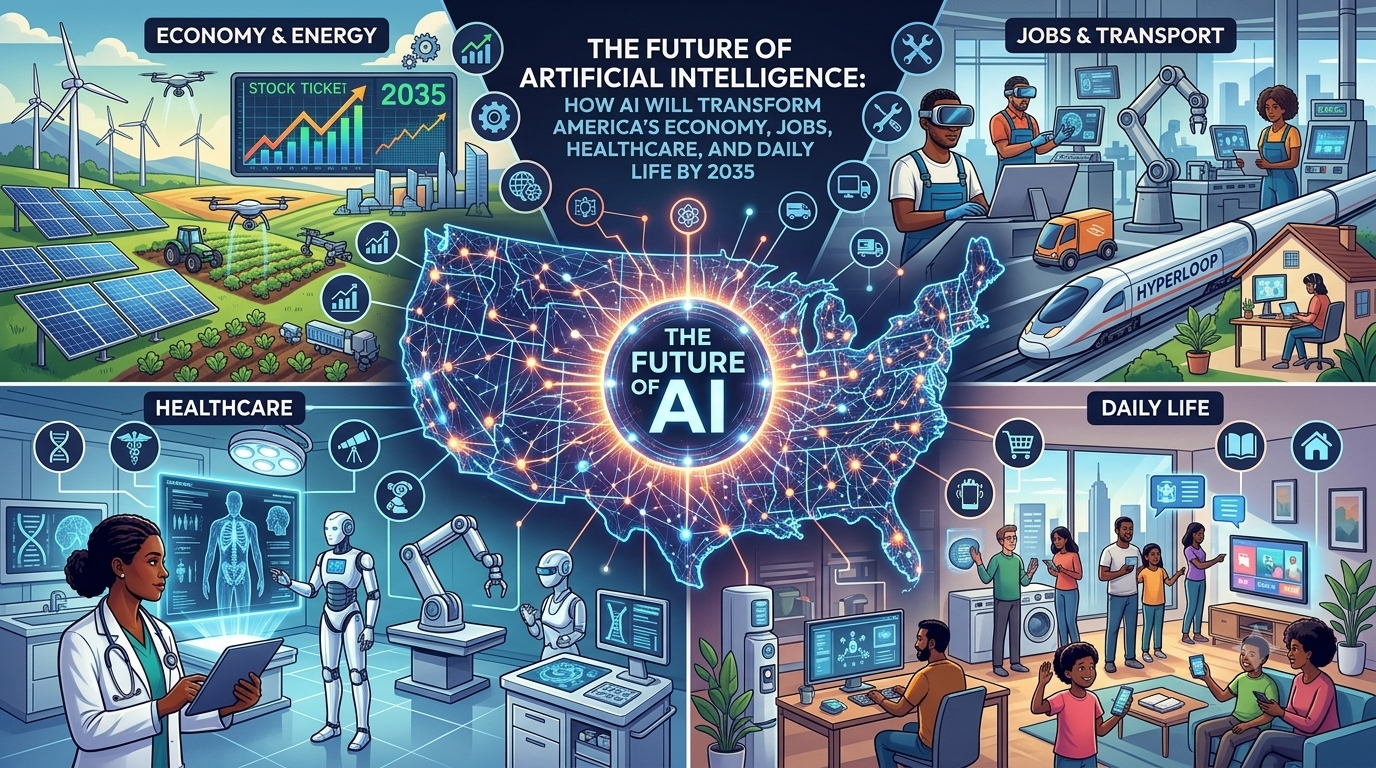
Artificial Intelligence (AI) is no longer a futuristic concept reserved for science fiction movies. It has become one of the most powerful technologies driving innovation across the United States and around the world. From personalized recommendations on streaming platforms to advanced medical diagnostics and self-driving vehicles, AI is already influencing how people live, work, and interact with technology.
The rapid advancement of AI has sparked both excitement and concern. Supporters view it as a revolutionary force capable of solving some of humanity’s biggest challenges, while critics worry about privacy, job displacement, and ethical risks. Regardless of where one stands, one fact is undeniable: artificial intelligence is shaping the future at an unprecedented pace.
As we move toward 2035, AI is expected to become deeply integrated into nearly every aspect of society. Businesses are investing billions of dollars in AI technologies, governments are developing AI regulations, and consumers are increasingly relying on AI-powered tools in their daily lives.
This article explores the future of artificial intelligence, the opportunities it presents, the challenges it creates, and how it may transform America’s economy, workforce, healthcare system, education sector, and everyday experiences.
Understanding Artificial Intelligence
Artificial intelligence refers to computer systems designed to perform tasks that typically require human intelligence. These tasks include learning, reasoning, problem-solving, language understanding, pattern recognition, and decision-making.
Modern AI is powered by technologies such as:
- Machine Learning (ML)
- Deep Learning
- Neural Networks
- Natural Language Processing (NLP)
- Computer Vision
- Generative AI
Unlike traditional software, AI systems can learn from data and improve their performance over time. This ability to adapt and evolve makes AI uniquely powerful compared to previous technological innovations.
Today, AI is used in everything from online shopping and fraud detection to healthcare diagnostics and autonomous vehicles.
Why Artificial Intelligence Is Growing So Quickly
Several factors have contributed to the rapid growth of AI:
1. Massive Amounts of Data
Every day, individuals and businesses generate enormous volumes of data through smartphones, websites, sensors, social media platforms, and connected devices.
AI systems thrive on data. The more information available, the more accurate and intelligent these systems become.
2. Increased Computing Power
Cloud computing and advanced processors have dramatically increased computational capabilities. Tasks that once required days or weeks can now be completed in minutes.
3. Better Algorithms
Researchers continue to develop more sophisticated machine learning models capable of handling increasingly complex problems.
4. Business Demand
Organizations constantly seek ways to improve efficiency, reduce costs, and gain competitive advantages. AI offers solutions for all three objectives.
These factors have created the perfect environment for widespread AI adoption across industries.
How AI Is Transforming the American Economy
Artificial intelligence is becoming a major driver of economic growth in the United States.
Businesses are leveraging AI to:
- Automate repetitive tasks
- Improve productivity
- Enhance customer experiences
- Reduce operational costs
- Generate new revenue streams
Companies that successfully implement AI technologies often gain significant advantages over competitors.
Small Businesses and AI
Previously, advanced technology was accessible primarily to large corporations. Today, cloud-based AI tools have made sophisticated capabilities available to small businesses as well.
Small companies can now use AI for:
- Customer support chatbots
- Content creation
- Marketing automation
- Sales forecasting
- Data analysis
This democratization of AI is helping entrepreneurs compete more effectively in a digital economy.
AI and Economic Growth
Experts predict that AI could contribute trillions of dollars to the global economy over the coming decades. In America, AI is expected to play a crucial role in maintaining technological leadership and driving future innovation.
The Future of Jobs in an AI-Powered World
One of the most frequently discussed topics surrounding AI is its impact on employment.
Will AI replace jobs?
The answer is more complex than a simple yes or no.
Jobs Most Likely to Be Automated
Tasks that are repetitive, predictable, and rule-based face the highest automation risk.
Examples include:
- Data entry
- Basic bookkeeping
- Routine customer service
- Administrative processing
- Simple manufacturing tasks
AI systems can perform many of these activities faster and more efficiently than humans.
Jobs That Will Continue to Thrive
Roles requiring creativity, emotional intelligence, critical thinking, leadership, and complex decision-making are likely to remain highly valuable.
Examples include:
- Healthcare professionals
- Engineers
- Teachers
- Psychologists
- Business strategists
- Creative professionals
Rather than replacing workers entirely, AI will often serve as a productivity-enhancing tool.
New Careers Created by AI
The rise of AI is already creating new career opportunities such as:
- AI Engineers
- Machine Learning Specialists
- Prompt Engineers
- AI Ethics Consultants
- Data Scientists
- AI Product Managers
- Automation Strategists
The workforce of the future will increasingly require digital literacy and adaptability.
AI in Healthcare: A Revolution in Patient Care
Healthcare represents one of the most promising applications of artificial intelligence.
Medical professionals generate vast amounts of data through patient records, imaging scans, laboratory results, and research studies.
AI can analyze this information far more quickly than traditional methods.
Early Disease Detection
AI systems are helping doctors identify diseases earlier than ever before.
Applications include:
- Cancer detection
- Heart disease risk assessment
- Neurological disorder diagnosis
- Medical imaging analysis
Earlier detection often leads to more effective treatment and improved patient outcomes.
Personalized Medicine
Future healthcare may become highly personalized.
AI can analyze:
- Genetic information
- Medical history
- Lifestyle factors
- Treatment responses
This enables doctors to develop customized treatment plans tailored to individual patients.
Accelerated Drug Discovery
Developing new medications traditionally requires years of research and billions of dollars.
AI is helping researchers identify promising drug candidates much faster, potentially reducing development timelines significantly.
Generative AI: The Next Major Technology Revolution
Generative AI has emerged as one of the most transformative developments in recent years.
Unlike traditional software that follows predefined instructions, generative AI can create entirely new content.
Examples include:
- Articles
- Marketing copy
- Images
- Videos
- Software code
- Music
Impact on Business
Companies are increasingly using generative AI to:
- Create marketing campaigns
- Generate reports
- Develop software
- Improve customer support
- Produce training materials
This technology has the potential to dramatically increase productivity across industries.
Human-AI Collaboration
The future is unlikely to involve AI replacing humans completely.
Instead, successful organizations will focus on human-AI collaboration, combining human creativity with machine efficiency.
Artificial Intelligence and Education
Education is undergoing significant transformation through AI-powered learning technologies.
Traditional classrooms often struggle to accommodate different learning styles and paces.
AI can help solve this challenge.
Personalized Learning
AI systems can:
- Adapt lesson plans
- Identify knowledge gaps
- Recommend learning resources
- Provide real-time feedback
Students receive customized educational experiences tailored to their individual needs.
Supporting Teachers
AI can automate administrative tasks, allowing educators to focus more on teaching and student engagement.
This may improve educational outcomes while reducing teacher workloads.
Lifelong Learning
As technology evolves rapidly, continuous learning becomes increasingly important.
AI-powered educational platforms will play a critical role in helping workers develop new skills throughout their careers.
Smart Cities and the Future of Urban Living
Artificial intelligence is expected to become a foundational component of future cities.
Smart city technologies use AI to optimize urban infrastructure and services.
Traffic Management
AI can analyze traffic patterns in real time to:
- Reduce congestion
- Improve transportation efficiency
- Minimize travel times
Energy Optimization
Smart energy systems can reduce waste and improve sustainability by adjusting consumption based on demand.
Public Safety
AI-powered surveillance and predictive analytics may help emergency services respond more effectively to incidents.
As urban populations grow, AI-driven solutions could significantly improve quality of life.
AI and Cybersecurity
Cybersecurity threats continue to increase in both sophistication and frequency.
Traditional security methods often struggle to keep pace with modern attacks.
How AI Improves Security
AI systems can:
- Monitor network activity continuously
- Detect suspicious behavior
- Identify vulnerabilities
- Prevent fraud
- Respond to threats automatically
This proactive approach helps organizations strengthen defenses against cybercriminals.
The Cybersecurity Arms Race
While AI strengthens security, attackers are also using AI to develop more advanced threats.
The future of cybersecurity will likely involve an ongoing battle between AI-powered defense systems and AI-enhanced attacks.
Ethical Challenges Facing Artificial Intelligence
Despite its benefits, AI presents several important ethical concerns.
Privacy
Many AI systems rely on large datasets containing personal information.
Organizations must ensure responsible data collection and protection practices.
Algorithmic Bias
AI systems can inherit biases present in training data.
Developers must actively work to ensure fairness and accuracy.
Transparency
As AI becomes more influential, people need greater visibility into how decisions are made.
Accountability
Questions remain regarding responsibility when AI systems make mistakes or cause harm.
Governments, businesses, and researchers are increasingly focused on developing ethical AI frameworks.
The Future of AI Regulation in America
As AI adoption accelerates, policymakers are working to establish appropriate regulations.
Effective regulation should:
- Encourage innovation
- Protect consumers
- Promote transparency
- Address security risks
Finding the right balance between innovation and oversight will be essential for sustainable AI growth.
The United States faces growing competition from other nations investing heavily in AI development. Maintaining leadership will require both technological advancement and responsible governance.
What Artificial Intelligence May Look Like in 2035
By 2035, AI could become as essential as electricity or the internet.
Possible developments include:
- Advanced virtual assistants managing daily tasks
- Fully personalized healthcare recommendations
- Autonomous transportation systems
- AI-powered scientific discoveries
- Highly intelligent business automation
- Real-time language translation
- Enhanced educational experiences
Many routine activities may become largely automated, allowing people to focus more on creativity, strategy, and interpersonal relationships.
Conclusion
Artificial intelligence is reshaping the modern world faster than almost any previous technology. Its impact is already visible across healthcare, business, education, transportation, cybersecurity, and countless other industries.
While challenges related to privacy, ethics, and workforce adaptation remain important, the opportunities presented by AI are extraordinary. Organizations that embrace responsible AI innovation will likely gain significant advantages in the coming years.
The future of artificial intelligence is not a distant vision—it is unfolding right now. By 2035, AI could become one of the most influential technologies in human history, transforming how Americans work, learn, communicate, receive healthcare, and interact with the world around them.
Those who understand, adapt to, and responsibly leverage AI will be best positioned to thrive in this rapidly evolving digital age.
Frequently Asked Questions (FAQ)
Will AI replace human jobs completely?
No. While AI will automate certain tasks, it is also expected to create new roles and enhance human productivity.
What industries benefit most from AI?
Healthcare, finance, manufacturing, education, transportation, retail, and cybersecurity are among the industries seeing significant AI adoption.
Is AI safe?
AI can be highly beneficial when developed and used responsibly. Proper regulation, transparency, and ethical standards are essential.
What skills are important for an AI-driven future?
Critical thinking, creativity, communication, digital literacy, data analysis, and problem-solving will remain highly valuable.
How will AI affect everyday life?
AI is expected to improve healthcare, transportation, education, customer service, productivity, and personalized digital experiences.


