







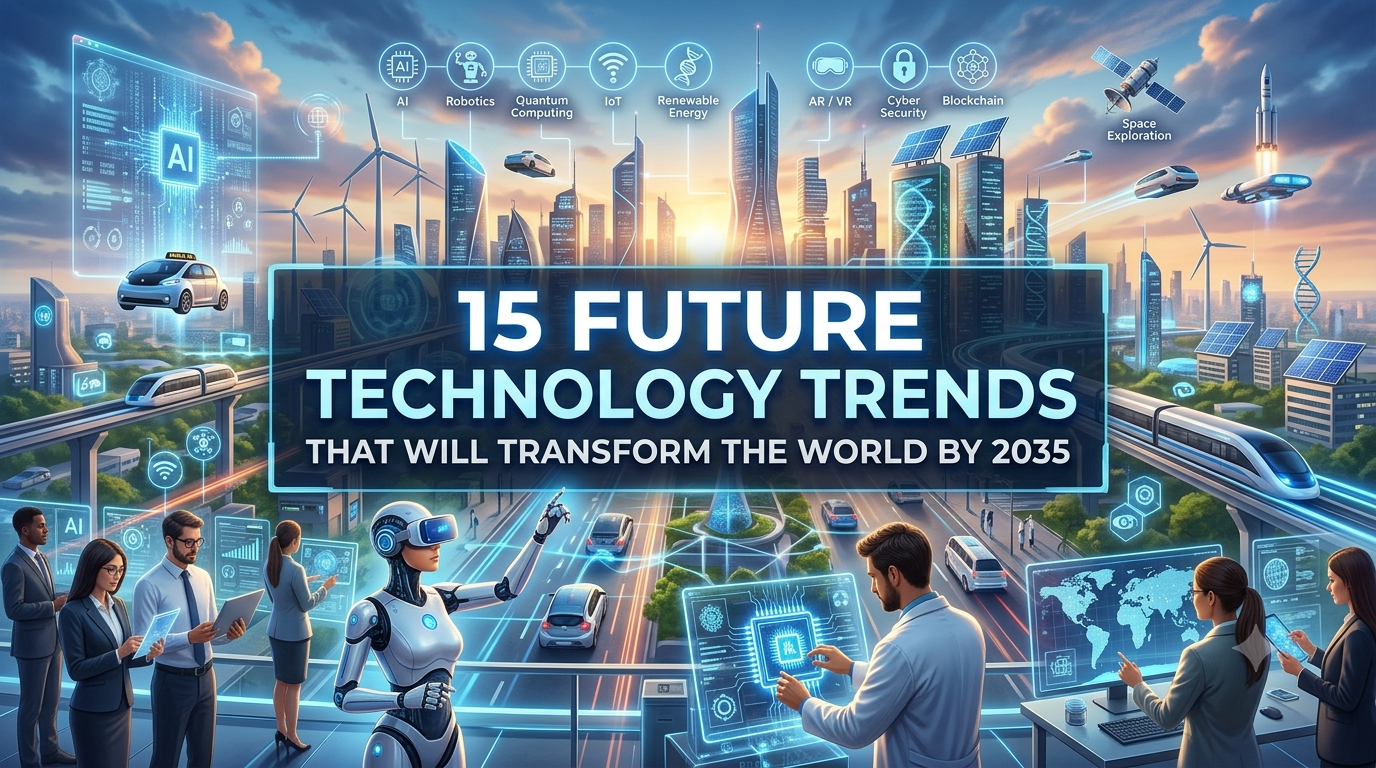
The pace of technological innovation has never been faster. Just a decade ago, artificial intelligence, self-driving vehicles, and virtual reality seemed like concepts reserved for science fiction. Today, these innovations are becoming part of everyday life, and by 2035, they are expected to reshape industries, economies, and the way people live and work.
The United States continues to lead the world in research, entrepreneurship, and digital transformation. Technology giants, innovative startups, and government initiatives are investing billions of dollars into developing solutions that will define the next generation of human progress.
Whether you’re a business owner, investor, student, or technology enthusiast, understanding these future technology developments can help you prepare for the opportunities ahead. The rise of emerging technologies will not only create new industries but also redefine existing ones through continuous innovation.
In this guide, we’ll explore the 15 biggest technology trends expected to transform the world by 2035.
1. Artificial Intelligence Will Become Smarter Than Ever
Artificial Intelligence (AI) has already transformed customer service, healthcare, education, and finance. By 2035, AI will become significantly more advanced, capable of handling complex decision-making and solving problems that currently require human expertise.
Businesses across the United States are already integrating AI into marketing, manufacturing, cybersecurity, and customer support. Future AI systems will analyze enormous amounts of data in seconds, helping organizations improve efficiency and reduce costs.
Instead of replacing humans, AI will increasingly serve as an intelligent partner, allowing professionals to focus on creativity, strategic planning, and innovation.
2. Quantum Computing Will Revolutionize Problem Solving
Traditional computers process information using binary bits. Quantum computers operate using qubits, enabling them to solve highly complex calculations exponentially faster.
Although still developing, quantum computing has enormous potential.
By 2035, quantum computers may help scientists:
- Discover new medicines faster
- Improve weather forecasting
- Develop stronger cybersecurity systems
- Optimize global supply chains
- Solve climate modeling challenges
Major technology companies and research institutions across America continue investing heavily in this breakthrough field, making quantum computing one of the most promising emerging technologies of the next decade.
3. Robotics and Intelligent Automation
Robots are no longer limited to automobile factories.
Future robots will assist in healthcare, agriculture, construction, logistics, hospitality, and even household tasks.
Powered by AI and advanced sensors, robots will perform dangerous, repetitive, and physically demanding jobs while improving workplace safety and productivity.
Examples include:
- Warehouse automation
- Robotic surgeons
- Agricultural harvesting robots
- Home assistant robots
- Disaster response machines
As labor shortages continue in several industries, robotics will become an essential component of business growth.
4. Biotechnology and Gene Editing
Healthcare is entering a revolutionary era.
Biotechnology combines medicine, genetics, and engineering to improve human health.
By 2035, personalized medicine will become increasingly common, allowing doctors to develop treatments specifically tailored to each individual’s DNA.
Gene-editing technologies could eventually help eliminate inherited diseases, while lab-grown organs may significantly reduce transplant waiting lists.
The United States is already leading biotechnology research, making this one of the most exciting technology trends for the coming decade.
5. Autonomous Vehicles and Smart Transportation
Self-driving technology continues improving every year.
By 2035, autonomous transportation could become a standard part of American cities.
Future transportation systems may include:
- Driverless taxis
- Autonomous trucks
- AI-controlled public transportation
- Drone deliveries
- Smart highways
These innovations promise safer roads, lower transportation costs, reduced traffic congestion, and greater fuel efficiency.
Businesses will also benefit from faster logistics and lower operating expenses through intelligent fleet management systems.
6. Extended Reality (AR, VR & Mixed Reality)
The future of digital experiences extends far beyond gaming.
Augmented Reality (AR), Virtual Reality (VR), and Mixed Reality (MR) are expected to transform education, healthcare, retail, engineering, and remote work.
Imagine attending business meetings through immersive virtual offices or medical students practicing surgeries inside realistic simulations.
Retailers may allow customers to virtually try furniture inside their homes before making purchases.
These immersive experiences will blur the boundaries between physical and digital environments, creating entirely new business opportunities.
7. 6G Networks and Hyper-Connected Communication
While many countries are still expanding 5G coverage, researchers are already developing 6G technology.
By 2035, 6G networks could offer speeds hundreds of times faster than current mobile internet while delivering almost zero latency.
This next-generation connectivity will power:
- Smart cities
- Autonomous vehicles
- Remote robotic surgery
- AI-powered manufacturing
- Real-time virtual reality
- Massive Internet of Things ecosystems
Faster communication infrastructure will become the foundation for nearly every major technological advancement expected over the next decade.
8. Internet of Things (IoT) Will Connect Everything
The Internet of Things refers to billions of connected devices that communicate with each other through the internet.
By 2035, smart devices will extend far beyond phones and watches.
Homes, offices, factories, vehicles, hospitals, and entire cities will operate through interconnected sensors that automatically collect and share data.
Examples include:
- Smart refrigerators ordering groceries automatically
- Intelligent traffic signals reducing congestion
- Connected healthcare devices monitoring patients remotely
- Smart factories optimizing production in real time
- Energy-efficient buildings reducing electricity consumption
The continued expansion of IoT represents one of the most influential future technology trends, improving efficiency across virtually every industry.
Why These Technology Trends Matter
The technologies discussed above are not developing independently. Instead, they are increasingly working together.
For example:
- Artificial Intelligence powers robotics.
- 6G enables autonomous vehicles.
- Quantum computing accelerates biotechnology research.
- IoT generates data for AI systems.
- Extended Reality enhances remote collaboration.
This convergence will create entirely new industries and business models while transforming existing ones.
Companies that embrace these innovations early will likely gain a significant competitive advantage in the rapidly evolving digital economy.
Coming Up in Part 2
In the second half of this guide, we’ll explore:
- Blockchain & Web3
- Green Technology
- Space Technology
- Nanotechnology
- Brain-Computer Interfaces
- AI-Powered Cybersecurity
- Digital Twins & Smart Cities
- Frequently Asked Questions
- Final Thoughts on the Tech Future
9. Blockchain and Web3 Will Transform Digital Ownership
While blockchain technology is best known for powering cryptocurrencies, its future extends far beyond digital currencies. By 2035, blockchain is expected to become a foundational technology for secure digital transactions, identity management, and decentralized applications.
Web3 aims to give users greater control over their personal data rather than relying on centralized platforms. Businesses may use blockchain to improve supply chain transparency, secure contracts, and streamline financial transactions.
Potential applications include:
- Digital identity verification
- Secure online voting
- Smart contracts
- Transparent supply chains
- Decentralized finance (DeFi)
- Digital asset ownership
As cybersecurity and privacy concerns continue to grow, blockchain will play a significant role in building trust across digital ecosystems.
10. Green Technology and Clean Energy Innovation
Climate change has accelerated the demand for sustainable solutions. By 2035, green technology is expected to become one of the fastest-growing sectors in the world.
Governments and businesses across the United States are investing in renewable energy, electric vehicles, battery storage, and carbon reduction technologies.
Future innovations may include:
- Advanced solar panels
- Next-generation wind farms
- Hydrogen-powered transportation
- Carbon capture systems
- Smart energy grids
- Sustainable manufacturing
These technologies will reduce environmental impact while creating millions of new jobs and supporting long-term economic growth.
Green technology represents one of the most important areas of innovation for the next generation.
11. Space Technology Will Create New Industries
Space exploration is no longer limited to government agencies. Private aerospace companies are rapidly expanding the commercial space industry, opening new possibilities for research, communications, and even tourism.
By 2035, space technology could become a major contributor to the global economy.
Future developments may include:
- Commercial space stations
- Lunar research missions
- Satellite internet expansion
- Space-based manufacturing
- Asteroid resource exploration
- Regular space tourism
Advances in reusable rockets and satellite technology are already reducing costs, making space more accessible than ever before.
For businesses, this creates opportunities in telecommunications, logistics, defense, agriculture, and climate monitoring.
12. Nanotechnology Will Change Manufacturing and Medicine
Nanotechnology involves manipulating materials at the molecular and atomic level. Although invisible to the naked eye, its impact could be enormous.
By 2035, nanotechnology may transform industries such as healthcare, electronics, construction, and energy.
Potential applications include:
- Targeted cancer treatments
- Self-healing construction materials
- Ultra-lightweight vehicles
- High-capacity batteries
- Water purification systems
- Flexible electronic devices
Scientists continue developing nanoscale materials that are stronger, lighter, and more efficient than traditional materials.
This rapidly evolving field demonstrates how emerging technologies can solve complex global challenges.
13. Brain-Computer Interfaces Will Change Human Communication
Brain-Computer Interfaces (BCIs) may sound futuristic, but significant progress is already being made.
BCIs create direct communication between the human brain and computers, allowing users to control digital devices using neural signals.
By 2035, these systems may help:
- Restore mobility for paralyzed patients
- Improve communication for individuals with disabilities
- Enhance learning experiences
- Increase workplace productivity
- Support advanced medical treatments
Although widespread adoption will require careful ethical and privacy considerations, BCIs could become one of the most revolutionary developments in the tech future.
14. AI-Powered Cybersecurity Will Protect the Digital World
As businesses become more connected, cyber threats continue growing in both scale and sophistication.
Traditional cybersecurity methods are no longer enough.
Artificial intelligence is becoming a powerful tool for detecting suspicious behavior, preventing attacks, and responding to threats in real time.
Future cybersecurity systems may automatically:
- Detect ransomware attacks
- Prevent identity theft
- Monitor network activity
- Identify software vulnerabilities
- Respond to cyber incidents within seconds
For organizations across the United States, investing in AI-powered security solutions will become essential as digital transformation accelerates.
Cybersecurity will remain one of the most important technology trends over the next decade.
15. Digital Twins and Smart Cities
One of the most exciting future technology developments is the rise of Digital Twins.
A Digital Twin is a virtual replica of a physical object, building, factory, or even an entire city. By collecting real-time data from sensors, these digital models allow engineers and city planners to monitor performance, predict problems, and optimize operations before issues occur.
When combined with artificial intelligence, IoT, and 6G connectivity, Digital Twins will help power the smart cities of the future.
By 2035, cities could use Digital Twins to:
- Improve traffic flow and reduce congestion
- Monitor bridges, roads, and public infrastructure
- Optimize energy consumption
- Predict maintenance needs
- Enhance emergency response systems
- Improve urban planning
For residents, this means safer neighborhoods, lower energy costs, cleaner environments, and better public services. For businesses, Digital Twins will improve efficiency while reducing operational expenses.
As urban populations continue to grow, Digital Twins will become a critical component of modern city planning and one of the defining innovations of the tech future.
How Businesses Can Prepare for the Future
The technologies discussed in this guide are already influencing business decisions today. Companies that begin adapting now will be better positioned to compete in tomorrow’s economy.
Business leaders should focus on:
- Investing in AI and automation tools
- Strengthening cybersecurity strategies
- Upskilling employees with digital skills
- Exploring data-driven decision making
- Monitoring advancements in emerging technologies
- Building flexible digital infrastructure
Preparing early allows organizations to innovate faster and respond more effectively to changing market demands.
Frequently Asked Questions (FAQ)
What is future technology?
Future technology refers to new and developing innovations that are expected to transform industries, businesses, and everyday life over the coming years. Examples include artificial intelligence, quantum computing, robotics, biotechnology, and smart cities.
Which technology will have the biggest impact by 2035?
Artificial Intelligence is expected to have the greatest impact because it will enhance nearly every industry, including healthcare, finance, transportation, manufacturing, education, and cybersecurity.
What are emerging technologies?
Emerging technologies are innovations that are still developing but have the potential to significantly reshape society and the global economy. Examples include blockchain, quantum computing, brain-computer interfaces, nanotechnology, and Digital Twins.
Will technology replace human jobs?
Technology will automate many repetitive tasks, but it is also expected to create entirely new careers. Professionals who continue learning and developing digital skills will remain highly valuable in the future workforce.
Why is innovation important for businesses?
Innovation helps businesses improve efficiency, reduce costs, create better customer experiences, and remain competitive in rapidly changing markets.
Final Thoughts
The journey toward 2035 is already underway. Artificial intelligence, quantum computing, robotics, biotechnology, blockchain, clean energy, Digital Twins, and other emerging technologies are rapidly moving from research labs into everyday life.
These technology trends will reshape how businesses operate, how cities function, and how people interact with the world around them. Organizations that embrace innovation today will be better prepared for tomorrow’s opportunities, while individuals who invest in continuous learning will remain competitive in an increasingly digital economy.
The tech future isn’t something to fear—it’s something to prepare for. Whether you’re an entrepreneur, investor, student, or technology enthusiast, staying informed about future technology will help you make smarter decisions and seize the opportunities of the next decade.
The world of 2035 will be more connected, intelligent, and sustainable than ever before. Those who adapt early won’t just witness the future—they’ll help create it.


