







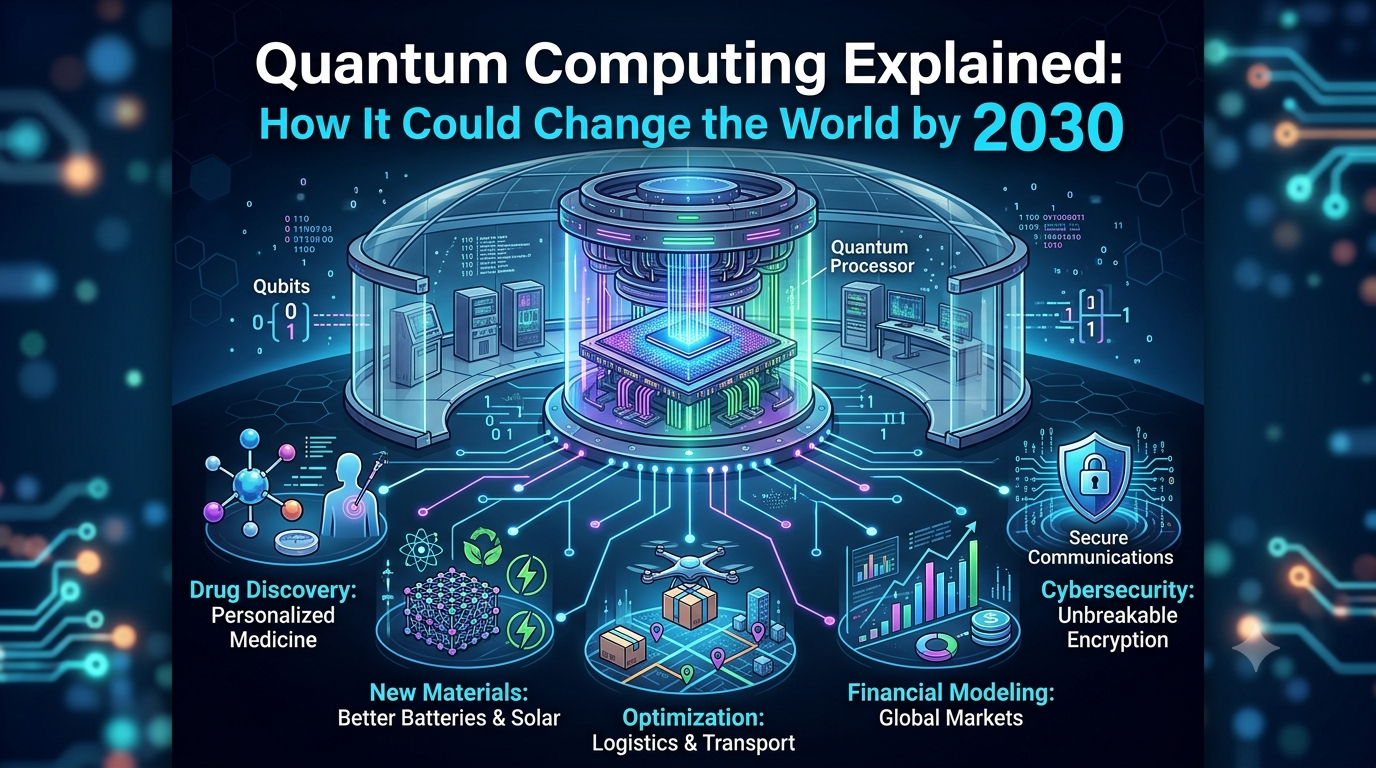
Technology is evolving at an unprecedented pace, and one of the most exciting breakthroughs on the horizon is quantum computing. While artificial intelligence, cloud computing, and automation continue to reshape industries, quantum computing has the potential to solve problems that today’s most powerful supercomputers simply cannot handle.
Although the concept sounds like science fiction, it is becoming a reality. Major technology companies, including IBM, Google, Microsoft, Amazon, and Intel, are investing billions of dollars into quantum research. Governments across the United States, Europe, and Asia are also funding quantum initiatives because they believe this technology will become one of the defining innovations of the next decade.
Experts predict that by 2030, quantum computing will begin transforming industries such as healthcare, cybersecurity, finance, logistics, artificial intelligence, climate science, and pharmaceutical research. While we may not all own quantum computers at home, businesses and researchers are expected to benefit significantly from their incredible processing capabilities.
In this guide, we’ll explain quantum computing in simple terms, explore how it works, discuss its real-world applications, and examine how it could change the world before the end of this decade.
What Is Quantum Computing?
Quantum computing is a new type of computing technology that uses the principles of quantum mechanics, the branch of physics that explains how particles behave at extremely small scales.
Traditional computers process information using bits, where every bit is either 0 or 1.
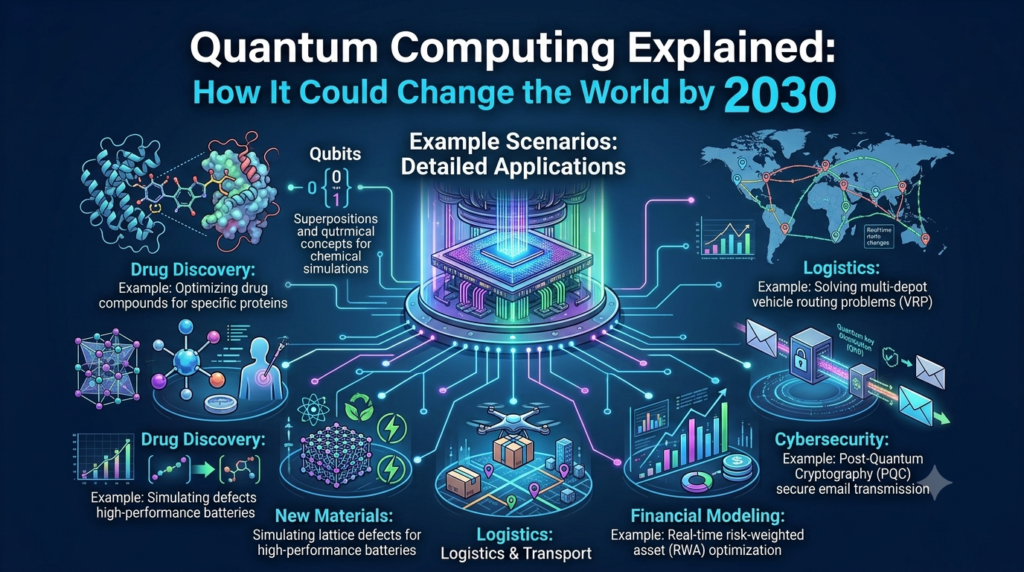
Quantum computers use quantum bits, commonly called qubits.
Unlike normal bits, qubits can represent 0, 1, or both simultaneously through a phenomenon called superposition. This unique capability allows quantum computers to process enormous numbers of possibilities at the same time instead of checking them one by one.
Think of it this way:
A traditional computer solves a maze by testing every possible path individually.
A quantum computer can evaluate many possible paths simultaneously, dramatically reducing the time required for complex calculations.
This difference makes quantum computers exceptionally powerful for solving specific types of computational problems.

How Does Quantum Computing Work?
Quantum computing relies on several unique principles of quantum physics.
1. Superposition
Superposition allows a qubit to exist in multiple states simultaneously.
Instead of being limited to either 0 or 1, a qubit can effectively represent both until it is measured.
As more qubits are added, the number of possible combinations grows exponentially, giving quantum computers extraordinary computational potential.
2. Entanglement
Entanglement is another fascinating property of quantum mechanics.
When two qubits become entangled, they remain connected regardless of the distance between them.
Changing one qubit instantly influences the other, enabling quantum computers to coordinate calculations far more efficiently than classical systems.
3. Quantum Interference
Quantum interference helps quantum algorithms amplify correct solutions while reducing incorrect ones.
Rather than simply calculating answers faster, quantum computers manipulate probabilities to increase the likelihood of finding the optimal solution.
This is one reason why quantum computing is especially useful for optimization and simulation problems.
Why Is Quantum Computing So Important?
Today’s computers are incredibly powerful.
However, many real-world challenges involve millions—or even billions—of possible combinations.
For example:
- Discovering new medicines
- Predicting weather patterns
- Optimizing airline schedules
- Designing advanced batteries
- Managing global supply chains
- Simulating chemical reactions
These problems often take traditional computers weeks, months, or even years to solve.
Quantum computers could reduce many of these calculations to hours or minutes, making breakthroughs possible across countless industries.
Industries That Quantum Computing Will Transform
1. Healthcare and Drug Discovery
One of the biggest opportunities lies in medicine.
Developing new drugs is an incredibly expensive and time-consuming process.
Scientists must simulate how molecules interact with each other, but current computers struggle to accurately model complex molecular structures.
Quantum computers could simulate these interactions with far greater precision.
Benefits may include:
- Faster vaccine development
- Personalized medicine
- Better cancer treatments
- Improved genetic research
- Reduced pharmaceutical research costs
By 2030, quantum computing could significantly shorten the timeline for discovering life-saving medicines.
2. Artificial Intelligence
Artificial intelligence already powers virtual assistants, recommendation systems, autonomous vehicles, fraud detection, and business automation.
However, AI models continue growing larger and more complex.
Training these models requires enormous computational resources.
Quantum computing may dramatically improve:
- Machine learning optimization
- Neural network training
- Pattern recognition
- Large-scale data analysis
- Decision-making algorithms
Instead of replacing AI, quantum computing will likely make artificial intelligence smarter, faster, and more efficient.
The combination of AI and quantum computing could become one of the most transformative technological partnerships of the next decade.
3. Cybersecurity
Cybersecurity is both one of quantum computing’s greatest opportunities and its biggest challenges.
Today’s internet relies heavily on encryption methods such as RSA and ECC, which protect:
- Online banking
- Credit card transactions
- Government communications
- Medical records
- Business data
- Cloud services
Powerful quantum computers may eventually break some of these encryption systems much faster than classical computers.
As a result, governments and technology companies are already developing post-quantum cryptography—new encryption standards designed to remain secure even in a quantum future.
This transition is expected to become increasingly important before 2030.
4. Quantum Computing in Finance
The financial industry relies on processing enormous amounts of data every second. Banks, investment firms, insurance companies, and fintech businesses analyze market trends, detect fraud, manage investment portfolios, and calculate financial risks. Many of these tasks involve solving highly complex mathematical problems that require tremendous computing power.
Quantum computing could revolutionize the finance sector by enabling institutions to make faster and more accurate decisions.
Potential applications include:
- Portfolio Optimization: Finding the best investment combinations while minimizing risk.
- Fraud Detection: Identifying suspicious transactions in real time.
- Risk Analysis: Running millions of financial scenarios much faster than traditional computers.
- Market Predictions: Enhancing predictive models for stock market analysis.
- Algorithmic Trading: Processing massive datasets instantly to execute smarter trades.
By 2030, quantum computing could become an essential tool for financial institutions seeking a competitive advantage.
5. Climate Change and Environmental Research
Climate change remains one of the world’s biggest challenges, and understanding Earth’s climate systems requires enormous computational resources.
Scientists use supercomputers to simulate weather patterns, predict hurricanes, study ocean currents, and model carbon emissions. However, these simulations often take days or even weeks to complete.
Quantum computers could significantly improve climate modeling by processing complex environmental data much more efficiently.
Potential benefits include:
- More accurate weather forecasting
- Better hurricane and flood predictions
- Improved renewable energy technologies
- Enhanced carbon capture research
- Faster battery material discovery
- Smarter energy grid optimization
These advancements could help governments and researchers make better decisions to combat climate change.
6. Manufacturing and Supply Chain Optimization
Global supply chains are incredibly complex. Every day, companies must decide how to transport products, schedule manufacturing, reduce fuel costs, and manage inventory efficiently.
Even small improvements can save millions of dollars annually.
Quantum computing excels at solving optimization problems, making it ideal for industries like:
- Manufacturing
- Shipping
- Airlines
- Retail
- Logistics
- E-commerce
Possible applications include:
- Optimizing delivery routes
- Reducing warehouse costs
- Improving inventory management
- Minimizing transportation delays
- Increasing production efficiency
As global commerce continues expanding, quantum optimization could become one of the most valuable business technologies of the decade.
7. Space Exploration and Scientific Discovery
Space agencies process massive amounts of scientific data from satellites, telescopes, and space missions.
Quantum computing could accelerate discoveries by helping scientists:
- Analyze astronomical data
- Simulate planetary environments
- Design advanced spacecraft materials
- Improve satellite communication
- Solve complex astrophysics problems
Researchers also believe quantum computers could accelerate breakthroughs in chemistry, physics, and materials science, leading to innovations that are difficult to imagine today.
Challenges Facing Quantum Computing
Despite its incredible potential, quantum computing is still in its early stages.
Several major challenges must be overcome before widespread adoption becomes possible.
1. Hardware Stability
Qubits are extremely sensitive to heat, vibrations, and electromagnetic interference. Even tiny environmental changes can introduce errors into calculations.
2. Error Correction
Quantum systems produce more errors than classical computers.
Scientists are developing advanced error-correction techniques, but they require many additional qubits, making today’s quantum machines difficult to scale.
3. High Costs
Building and maintaining quantum computers is expensive.
Many systems require temperatures colder than outer space, using specialized refrigeration equipment that costs millions of dollars.
4. Limited Practical Applications
Although researchers have demonstrated impressive breakthroughs, quantum computers currently outperform classical computers only for specific types of problems.
For everyday tasks like browsing the internet, gaming, or using office software, traditional computers remain far more practical.
Will Quantum Computers Replace Traditional Computers?
One of the biggest misconceptions is that quantum computers will replace laptops and desktop PCs.
The answer is no.
Instead, quantum computers will work alongside classical computers.
Traditional computers will continue handling everyday activities such as:
- Video streaming
- Social media
- Programming
- Office work
- Gaming
- Graphic design
Quantum computers will instead focus on solving specialized problems involving massive datasets, scientific simulations, optimization, and advanced artificial intelligence.
Think of quantum computers as highly specialized tools rather than replacements for conventional machines.
What Could Happen by 2030?
Experts believe the next few years will mark a turning point for quantum technology.
By 2030, we are likely to see:
- Cloud-based quantum computing services becoming more accessible to businesses.
- Pharmaceutical companies using quantum simulations to accelerate drug discovery.
- Banks adopting quantum-powered financial modeling.
- Logistics companies optimizing global supply chains with quantum algorithms.
- AI systems becoming more efficient through quantum-enhanced machine learning.
- Governments implementing post-quantum cybersecurity standards to protect sensitive data.
- Universities expanding quantum computing education to prepare the next generation of scientists and engineers.
While fully fault-tolerant quantum computers may still be under development, their commercial impact is expected to grow steadily throughout the decade.
Should Businesses Start Preparing Now?
Absolutely.
Even if your business doesn’t directly use quantum computers today, understanding the technology can provide a competitive edge.
Companies should consider:
- Monitoring advancements in quantum technology.
- Investing in employee education and training.
- Exploring cloud-based quantum computing platforms.
- Preparing for post-quantum cybersecurity standards.
- Identifying business problems that could benefit from quantum optimization.
Organizations that begin planning early will be better positioned to take advantage of future breakthroughs.
Final Thoughts
Quantum computing is no longer just a theoretical concept confined to research laboratories—it is rapidly becoming one of the most promising technologies of the 21st century. Although widespread commercial adoption will take time, the progress made over the last few years suggests that quantum computing could redefine how humanity solves some of its most difficult problems.
From discovering life-saving medicines and strengthening cybersecurity to optimizing global supply chains and advancing artificial intelligence, the possibilities are extraordinary. By 2030, quantum computing is expected to complement traditional computing rather than replace it, enabling innovations that were once considered impossible.
For businesses, students, developers, and technology enthusiasts, now is the perfect time to understand this emerging field. Those who embrace quantum computing early will be better prepared for the technological revolution that lies ahead.
Frequently Asked Questions (FAQs)
1. What is quantum computing in simple words?
Quantum computing is a type of computing that uses quantum mechanics to solve certain complex problems much faster than traditional computers.
2. Why is quantum computing important?
It can solve advanced scientific, medical, financial, and optimization problems that are beyond the capabilities of today’s classical computers.
3. Will quantum computers replace regular computers?
No. Quantum computers will work alongside traditional computers and will be used for specialized tasks.
4. Which industries will benefit the most?
Healthcare, pharmaceuticals, artificial intelligence, finance, logistics, manufacturing, cybersecurity, energy, and scientific research.
5. Is quantum computing available today?
Yes, but mainly through cloud-based platforms offered by leading technology companies. Current systems are still in the early stages of development.
6. What is a qubit?
A qubit is the basic unit of information in a quantum computer. Unlike a regular bit, it can exist in multiple states simultaneously.
7. Is quantum computing a threat to cybersecurity?
Future quantum computers could break some existing encryption methods, which is why researchers are developing post-quantum cryptography to protect digital information.
8. When will quantum computing become mainstream?
Many experts expect significant commercial growth between 2030 and 2040, although specialized business applications are already beginning to emerge.


