



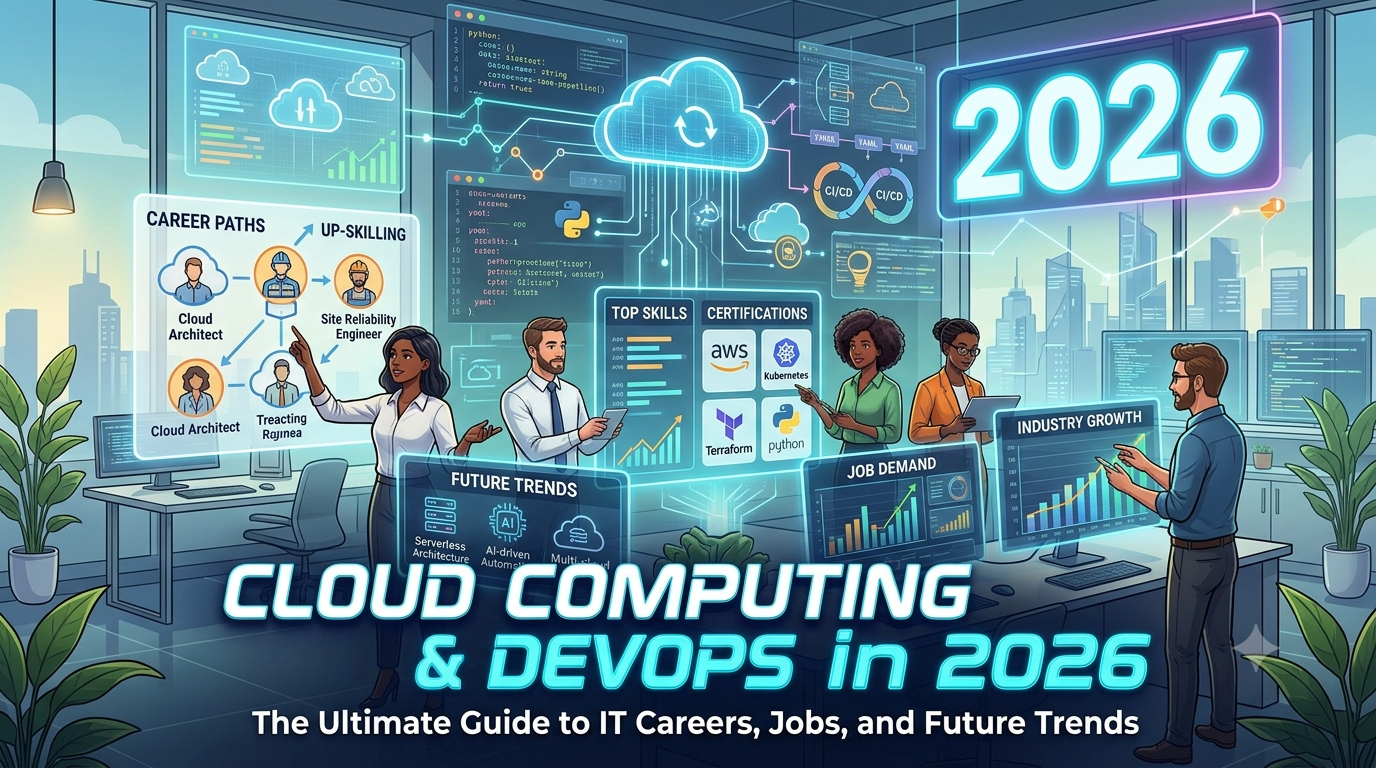
The IT industry has changed dramatically over the last decade, and no two technologies have had a bigger impact than Cloud Computing and DevOps. Businesses across the United States are moving away from traditional data centers and embracing cloud-first strategies that improve scalability, reduce costs, and accelerate innovation.
At the same time, DevOps has transformed how software is built, tested, and deployed. Organizations now expect developers, operations teams, and security professionals to work together seamlessly to deliver applications faster and more reliably than ever before.
As we move through 2026, companies ranging from startups to Fortune 500 enterprises are investing billions of dollars in cloud infrastructure, automation, and DevOps transformation. This demand has created thousands of high-paying jobs across the United States for professionals with cloud and DevOps expertise.
Whether you’re an aspiring IT professional, a software developer looking to upgrade your career, or someone considering switching into technology, understanding Cloud Computing and DevOps has become essential.
What is Cloud Computing?
Cloud Computing refers to delivering computing services—including servers, storage, databases, networking, software, analytics, and artificial intelligence—over the internet instead of relying on physical hardware located inside a company’s office.
Rather than purchasing expensive servers and maintaining them internally, businesses rent computing resources from cloud providers whenever needed.
This model allows organizations to:
- Reduce infrastructure costs
- Scale applications instantly
- Improve disaster recovery
- Increase business flexibility
- Support remote workforces
- Deploy software globally within minutes
Cloud Computing has become the backbone of modern digital businesses.
Why Cloud Computing is Dominating the IT Industry
The United States continues to lead global cloud adoption because organizations demand speed, scalability, and security.
Today almost every major industry depends on cloud technology:
- Healthcare
- Banking
- Retail
- E-commerce
- Manufacturing
- Government
- Education
- Artificial Intelligence
- Media & Entertainment
Even small businesses now use cloud platforms instead of investing in expensive local infrastructure.
As digital transformation accelerates, cloud adoption is expected to continue growing for years.
The Three Major Cloud Service Models
Understanding cloud service models is important for anyone planning a career in cloud technology.
1. Infrastructure as a Service (IaaS)
IaaS provides virtual servers, networking, storage, and operating systems.
Examples include:
- Virtual Machines
- Load Balancers
- Storage Services
- Networking
- Firewalls
Cloud engineers typically work extensively with IaaS.
2. Platform as a Service (PaaS)
PaaS gives developers everything they need to build applications without managing servers.
Benefits include:
- Faster development
- Automatic scaling
- Managed databases
- Built-in monitoring
- Simplified deployment
Developers spend more time writing code and less time maintaining infrastructure.
3. Software as a Service (SaaS)
SaaS delivers software directly through a web browser.
Examples include:
- CRM software
- Email services
- Collaboration tools
- Video conferencing
- Office productivity suites
Millions of businesses rely on SaaS products every day.
What is DevOps?
DevOps combines Development (Dev) and Operations (Ops) into one collaborative workflow.
Instead of developers writing code and handing it over to another team, DevOps encourages continuous collaboration throughout the software lifecycle.
The goal is to deliver software:
- Faster
- More securely
- With fewer bugs
- Through automated processes
- With continuous monitoring
DevOps is more than a technology—it is a culture that focuses on automation, communication, and continuous improvement.
Why DevOps Has Become Essential
Modern businesses cannot afford slow software releases.
Customers expect:
- Frequent updates
- Bug fixes
- New features
- Better security
- High availability
DevOps enables organizations to release software dozens—or even hundreds—of times per day without sacrificing quality.
This approach has become a competitive advantage for companies across the United States.
Core Principles of DevOps
Successful DevOps teams focus on several key principles.
Continuous Integration (CI)
Developers regularly merge code into a shared repository.
Benefits include:
- Faster testing
- Early bug detection
- Better collaboration
- Improved software quality
Continuous Delivery (CD)
Applications are automatically prepared for production after testing.
Advantages include:
- Faster releases
- Lower deployment risks
- Consistent deployments
- Improved reliability
Automation
Automation eliminates repetitive manual work.
Examples include:
- Infrastructure provisioning
- Testing
- Deployment
- Monitoring
- Security scanning
Automation saves organizations thousands of hours every year.
Monitoring
DevOps teams continuously monitor applications to identify problems before users notice them.
Monitoring includes:
- Performance metrics
- Server health
- Application logs
- User experience
- Security events
Cloud Computing and DevOps: Why They Work Together
Cloud Computing and DevOps complement each other perfectly.
Cloud platforms provide scalable infrastructure, while DevOps automates software delivery.
Together they enable organizations to:
- Launch applications faster
- Reduce downtime
- Improve scalability
- Increase security
- Lower operational costs
- Respond quickly to customer demands
This partnership has become the standard architecture for modern software companies.
Most Popular Cloud Platforms in 2026
Amazon Web Services (AWS)
AWS remains the world’s largest cloud provider.
Popular services include:
- EC2
- S3
- Lambda
- RDS
- CloudFormation
- ECS
- EKS
AWS skills remain among the highest-paying technical skills in the United States.
Microsoft Azure
Azure continues growing rapidly because many enterprises already use Microsoft products.
Azure integrates seamlessly with:
- Windows Server
- Microsoft 365
- Active Directory
- SQL Server
- Power Platform
Many Fortune 500 companies rely heavily on Azure infrastructure.
Google Cloud Platform (GCP)
Google Cloud excels in:
- Artificial Intelligence
- Machine Learning
- Kubernetes
- Big Data
- Analytics
Many AI startups choose Google Cloud because of its advanced AI ecosystem.
Most Popular DevOps Tools
Modern DevOps engineers use many specialized tools.
Some of the most in-demand include:
Docker
Containerizes applications for consistent deployment.
Kubernetes
Manages containers at enterprise scale.
Kubernetes has become one of the most valuable DevOps skills in today’s IT job market.
Jenkins
Automates software testing and deployment pipelines.
GitHub Actions
Simplifies CI/CD workflows directly from GitHub repositories.
Terraform
Allows engineers to build infrastructure using code.
Infrastructure as Code (IaC) has become an industry standard.
Ansible
Automates server configuration and application deployment.
Prometheus
Collects performance metrics from applications and infrastructure.
Grafana
Creates dashboards for monitoring systems in real time.
Cloud Security: A Growing Priority
As organizations migrate sensitive information to the cloud, cybersecurity has become increasingly important.
Cloud security professionals help protect:
- Customer data
- Financial records
- Healthcare information
- Government systems
- Enterprise applications
Key cloud security responsibilities include:
- Identity management
- Encryption
- Compliance
- Vulnerability management
- Threat detection
- Security monitoring
Cloud security specialists are among the highest-paid professionals in today’s technology industry.
Why Businesses Continue Investing in Cloud and DevOps
Organizations recognize that modern customers expect digital experiences that are:
- Fast
- Reliable
- Available 24/7
- Secure
- Continuously improving
Cloud Computing and DevOps provide the foundation for meeting these expectations while reducing operational costs and increasing innovation.
As a result, demand for skilled cloud and DevOps professionals continues to rise across the U.S. job market.
Cloud Computing & DevOps Career Opportunities in the USA
The demand for Cloud Computing and DevOps professionals has reached an all-time high across the United States. Companies are actively hiring skilled engineers to build scalable cloud infrastructure, automate software delivery, and improve cybersecurity.
From startups in Austin to enterprise organizations in New York, Seattle, and Silicon Valley, cloud expertise has become one of the most valuable technical skills in today’s IT job market.
Whether you are a recent graduate or an experienced software developer, cloud and DevOps offer outstanding career growth and long-term stability.
Highest-Paying Cloud Computing Jobs in 2026
One of the biggest reasons professionals switch to cloud computing is the excellent salary potential.
1. Cloud Engineer
Cloud Engineers design, deploy, and maintain cloud infrastructure.
Responsibilities
- Managing virtual servers
- Cloud migration
- Storage management
- Networking
- Infrastructure automation
- Performance optimization
Average USA Salary:
$110,000–$160,000 per year
2. DevOps Engineer
DevOps Engineers automate software deployment and infrastructure management.
Responsibilities
- CI/CD pipelines
- Infrastructure as Code
- Container management
- Monitoring systems
- Automation scripts
Average USA Salary:
$120,000–$180,000 annually
This remains one of the fastest-growing IT careers in America.
3. Site Reliability Engineer (SRE)
SRE professionals combine software engineering with IT operations to maximize uptime and system reliability.
Responsibilities
- Monitoring production systems
- Incident response
- Performance tuning
- Automation
- Capacity planning
Average Salary:
$130,000–$190,000
4. Cloud Security Engineer
Cybersecurity is becoming increasingly important as organizations migrate sensitive data to cloud platforms.
Cloud Security Engineers focus on:
- Identity Access Management (IAM)
- Threat detection
- Compliance
- Encryption
- Security monitoring
- Cloud governance
Average Salary
$130,000–$200,000
5. Cloud Solutions Architect
Solutions Architects design complete cloud infrastructure for organizations.
Responsibilities include:
- System architecture
- Cloud migration
- Disaster recovery
- Security planning
- Scalability
This role requires several years of experience but offers some of the highest salaries in the cloud industry.
Average Salary
$150,000–$220,000
Most In-Demand DevOps Skills
Employers no longer hire professionals based solely on programming knowledge.
Today’s DevOps engineers need expertise across multiple domains.
Linux Administration
Most cloud infrastructure runs on Linux.
Important skills include:
- Bash scripting
- User management
- File systems
- Networking
- Process management
Git & Version Control
Git is essential for every DevOps engineer.
Developers use Git for:
- Source code management
- Collaboration
- Branching strategies
- Release management
Docker Containers
Docker allows applications to run consistently across different environments.
Every DevOps professional should understand:
- Images
- Containers
- Dockerfiles
- Docker Compose
- Registries
Kubernetes
Kubernetes has become the standard platform for container orchestration.
Companies increasingly expect candidates to understand:
- Pods
- Services
- Deployments
- StatefulSets
- Helm
- Scaling
- Load balancing
Infrastructure as Code
Modern infrastructure is managed through code.
Popular tools include:
- Terraform
- Pulumi
- AWS CloudFormation
Infrastructure as Code reduces manual errors while improving consistency.
CI/CD Pipelines
Automation is the heart of DevOps.
Popular CI/CD platforms include:
- Jenkins
- GitHub Actions
- GitLab CI/CD
- Azure DevOps
Cloud Platforms
Most employers expect experience with at least one major cloud provider:
- Amazon Web Services (AWS)
- Microsoft Azure
- Google Cloud Platform (GCP)
Learning multiple cloud platforms increases job opportunities significantly.
Best Certifications for Cloud & DevOps Careers
Professional certifications help validate your skills and improve your resume.
AWS Certifications
Recommended path:
- AWS Certified Cloud Practitioner
- AWS Solutions Architect Associate
- AWS Developer Associate
- AWS SysOps Administrator
- AWS DevOps Engineer Professional
Microsoft Azure Certifications
Popular certifications include:
- Azure Fundamentals (AZ-900)
- Azure Administrator
- Azure Developer
- Azure Solutions Architect
Google Cloud Certifications
Leading options include:
- Associate Cloud Engineer
- Professional Cloud Architect
- Professional DevOps Engineer
Kubernetes Certification
The Certified Kubernetes Administrator (CKA) certification is highly respected by employers.
It demonstrates practical expertise in managing Kubernetes clusters.
Terraform Certification
HashiCorp Terraform certification validates Infrastructure as Code skills and is increasingly valued in enterprise environments.
Career Roadmap for Beginners
Breaking into Cloud Computing or DevOps doesn’t require a computer science degree, but it does require consistent learning and hands-on practice.
Step 1
Learn:
- Computer networking
- Operating systems
- Linux basics
- Command line
Step 2
Study one programming language such as:
- Python
- Go
- JavaScript
- Bash
Python is widely used for cloud automation and DevOps scripting.
Step 3
Learn Git and GitHub.
Build personal projects and maintain repositories to showcase your work.
Step 4
Choose one cloud platform.
AWS is the most common starting point because of its broad adoption and extensive learning resources.
Step 5
Master Docker.
Containerization is now a foundational skill for modern application deployment.
Step 6
Learn Kubernetes after becoming comfortable with Docker.
Understand how to deploy, scale, and manage containerized applications.
Step 7
Build CI/CD pipelines using tools like GitHub Actions or Jenkins.
Automate testing and deployments to demonstrate real-world DevOps workflows.
Step 8
Create a professional portfolio.
Include projects such as:
- Cloud-hosted web applications
- Automated deployment pipelines
- Kubernetes clusters
- Terraform infrastructure
- Monitoring dashboards
Employers often value practical projects as much as certifications.
AI is Transforming Cloud Computing and DevOps
Artificial Intelligence is reshaping how cloud infrastructure is managed.
AI-powered tools now assist engineers by:
- Detecting system failures
- Predicting infrastructure issues
- Optimizing cloud costs
- Improving application performance
- Enhancing security monitoring
- Automating repetitive tasks
Rather than replacing cloud and DevOps professionals, AI is enabling them to focus on higher-value engineering work.
Professionals who combine AI knowledge with cloud expertise are likely to have a strong advantage in the coming years.
Remote Work Opportunities
Cloud Computing and DevOps are among the best careers for remote work.
Many U.S.-based companies hire engineers from across the country—and, in some cases, internationally—for roles such as:
- Cloud Engineer
- DevOps Engineer
- Cloud Consultant
- Infrastructure Engineer
- Platform Engineer
- Site Reliability Engineer (SRE)
Remote positions often provide flexible schedules and access to global projects.
Future Trends Through 2035
The next decade is expected to bring even greater demand for cloud and DevOps professionals.
Key trends include:
Multi-Cloud Strategies
Organizations increasingly use multiple cloud providers to improve resilience and reduce vendor lock-in.
Serverless Computing
Developers will rely more on serverless architectures to reduce infrastructure management and improve scalability.
Platform Engineering
Internal developer platforms are becoming a priority, enabling engineering teams to build and deploy software more efficiently.
Edge Computing
As connected devices and IoT applications grow, processing data closer to users will become more important.
Cloud-Native Security
Security will be integrated into every stage of the software development lifecycle through DevSecOps practices.
AI-Powered Operations (AIOps)
AI will continue improving system monitoring, incident detection, and operational efficiency by helping teams identify patterns and respond more quickly.
Is Cloud Computing and DevOps a Good Career in 2026?
The answer is yes.
Cloud Computing and DevOps continue to rank among the most promising technology careers because they offer:
- High salaries
- Strong job demand
- Career flexibility
- Remote work opportunities
- Continuous learning
- Opportunities across nearly every industry
- Long-term career stability
Businesses are accelerating digital transformation, ensuring that skilled cloud and DevOps professionals remain in demand.
Final Thoughts
Cloud Computing and DevOps have become the foundation of modern IT infrastructure. Organizations of every size rely on cloud platforms, automation, and collaborative engineering practices to deliver secure, reliable, and scalable digital services.
For anyone planning a career in technology, learning cloud platforms, automation tools, containerization, and Infrastructure as Code is a strategic investment. By combining hands-on experience with certifications and a strong project portfolio, you can position yourself for rewarding opportunities in one of the fastest-growing areas of the IT industry.
Whether your goal is to become a Cloud Engineer, DevOps Engineer, Cloud Architect, or Site Reliability Engineer, the future looks exceptionally promising as businesses continue investing in cloud-first and cloud-native technologies.
Frequently Asked Questions (FAQs)
1. Is Cloud Computing a good career in the USA?
Yes. Cloud Computing remains one of the fastest-growing IT fields, offering competitive salaries, excellent job security, and opportunities across industries.
2. What is the difference between Cloud Computing and DevOps?
Cloud Computing focuses on delivering and managing computing resources over the internet, while DevOps emphasizes collaboration, automation, and continuous software delivery. Together, they enable organizations to build and operate modern applications efficiently.
3. Which cloud platform should beginners learn first?
AWS is often recommended for beginners due to its widespread industry adoption, comprehensive documentation, and large ecosystem. However, Azure and Google Cloud are also valuable depending on your career goals.
4. Does DevOps require coding?
Yes, basic programming or scripting knowledge—such as Python, Bash, or Go—is helpful for automating tasks, managing infrastructure, and building CI/CD pipelines.
5. Can I get a Cloud or DevOps job without a degree?
Yes. Many employers prioritize practical skills, certifications, and hands-on projects over formal degrees, especially when candidates can demonstrate real-world experience.
